🕸 Using Networks Science Models in Art and Design
Putting Network Effects to Use!
Small Worlds
Preferential Attachment
Power Laws
Scale-free networks
Hubs
Matthew Effect
Introduction
Here, we will see a few Network Behaviours and Network Effects, and understand how they could be useful tools in Art and Design!
Erdos and Renyi: Random Networks
Consider a set of nodes. Edges can appear randomly between any pair of nodes. Sounds familiar? This is exactly the Barabasi Cocktail Party Game we played earlier.
In many ways this is the most agnostic, or Null model that network scientists use, a network where there are no causes for connection except random ones. By this logic, anything that is not random, or even differently random would have some phenomenon lurking underneath! ( Apropos: A NULL Model is often used in Statistics. More here, on the Mad Hatter’s Guide to Data Viz and Stats ).
Implications:
- Degree Distribution: With random attachment, we get a “bell-curve” like situation, where seemingly nothing is happening. Most nodes have degrees close to the average; extremes are rare. There are not too many differences between nodes/people/agents. No one has a terrific viral network.
NoteMath Aside
(In G(n, p), the degree of a node follows a Binomial(n-1, p) distribution. For sparse networks (p small, average degree \(λ = p(n-1)\) fixed as n → ∞), this approximates a Poisson(λ) distribution. (More later when we meet Hamlet.)
-
Connectivity & Giant Component: There is a critical threshold for connectivity.:
- When average degree λ < 1: Many small components.
- At λ ≈ 1: Phase transition — a giant component emerges.
- λ > 1: Almost surely a single giant component containing most nodes. Suddenly, if everyone has on average one friend, it is a connected world. On average!!!
- Shortest Paths: Small diameter and average path length (logarithmic in n for connected regimes) — the “small world” property appears even in this simple model.
- Clustering: No community structure, correlations, or growth dynamics.
- No Hubs: Lacks the heavy-tailed degree distributions (hubs) seen in scale-free networks.
Why it matters in Art/Design?
- Good baseline to compare your Design ( assuming it is a network oriented thing ) to a random network. If your design is not better than random, there are improvements to be made!)
- The emergent
Giant Componentis a metaphor for market uptake of a product. It represents a point of inflexion, or a tipping point. - What can you do to create more correlated actions between nodes on a network? Then you have a better chance of growth dynamics setting in! (See below)
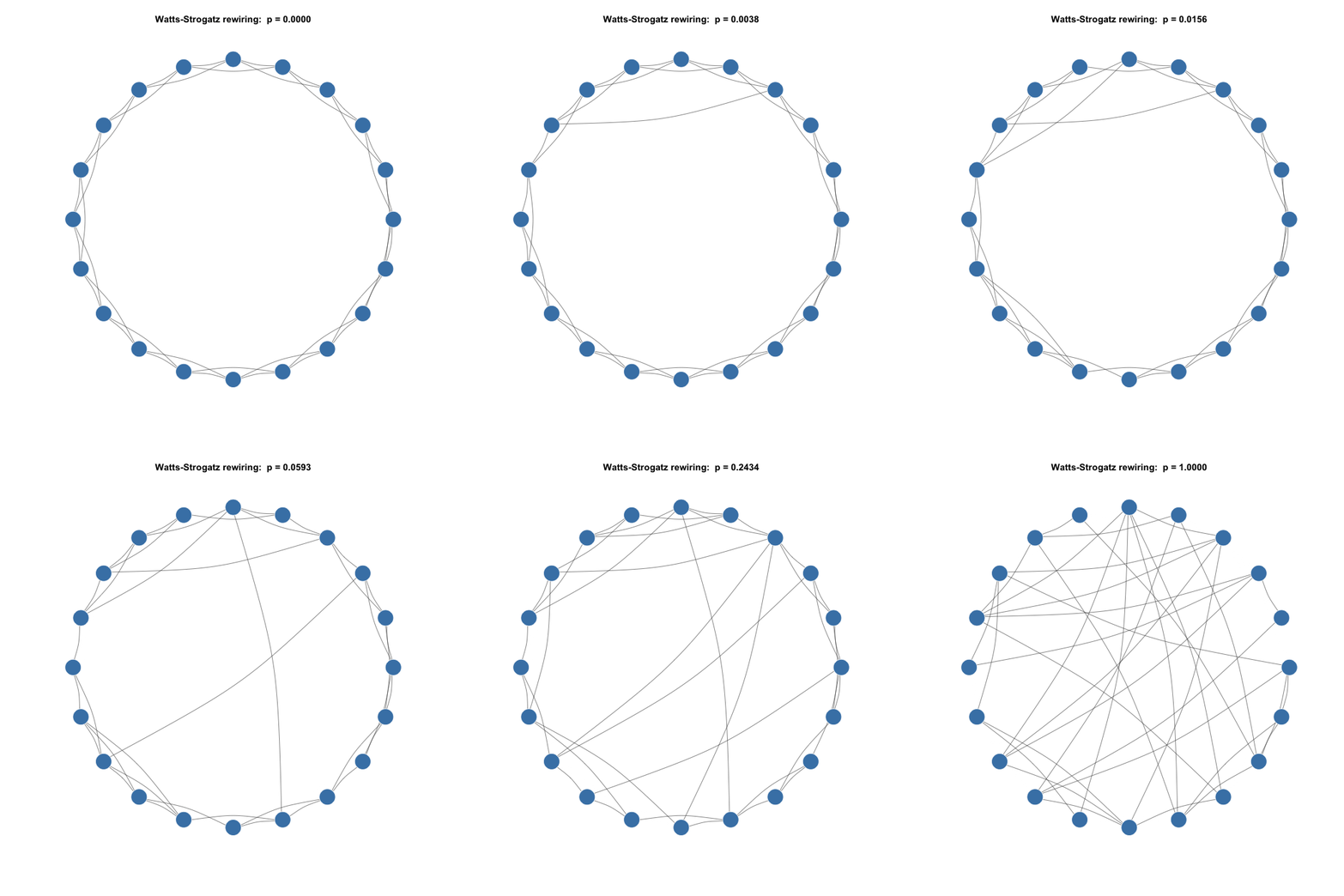
Watts and Strogatz: Small Worlds
“It’s a Small World” is a aphorism you must have heard before. Most times, it is uttered when you claim to know someone who knows someone you have just met! This seeming “leap of a connection” bridges across communities that may otherwise be isolated. That one small link jumping across “vast distances” seemingly compresses the network into a "Small World"!
Implications
-
Target audiencesthat may seem inaccessible, and very far, may suddenly be not far at all due to one “random link” that bridges communities - The World becomes smaller than you had thought
Why it matters in Art/Design?
- Try a very tenuous-looking, unlikely location to access a new community of users / artists / designers / collaborators?
- Put yourself / your art/design enterprise in dangerous positions?
- Try meeting communities or people very unlike yourself.
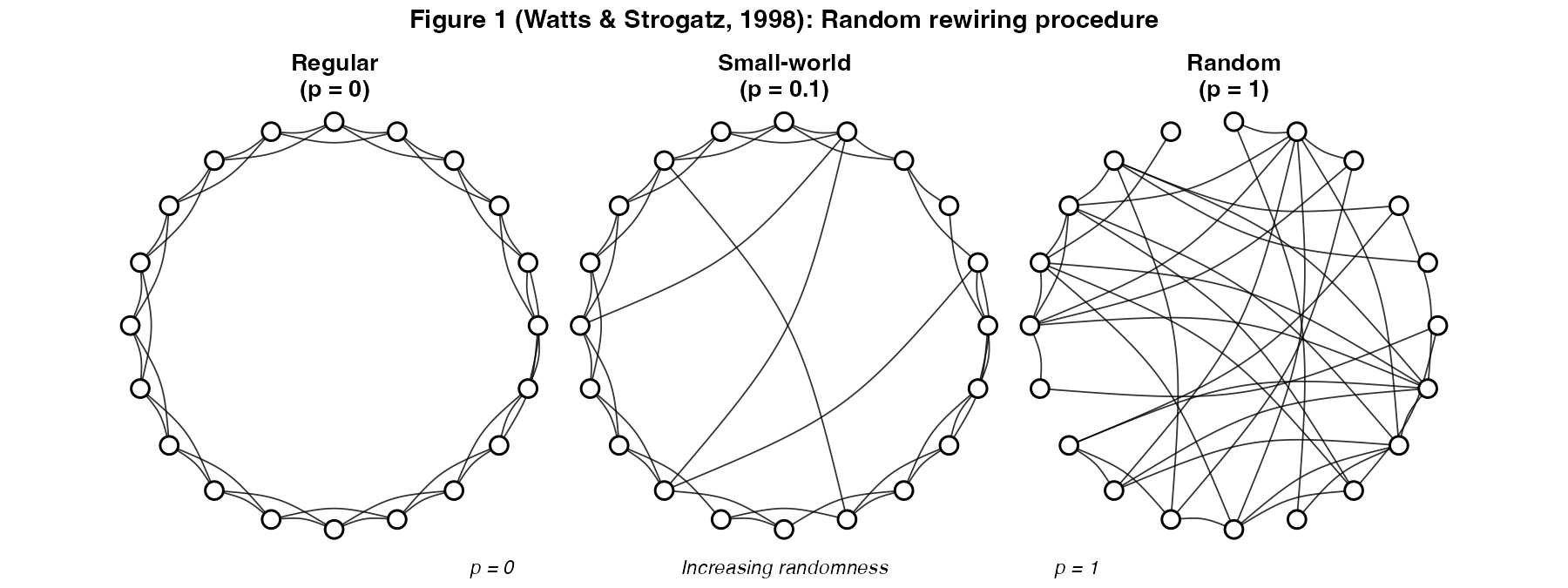
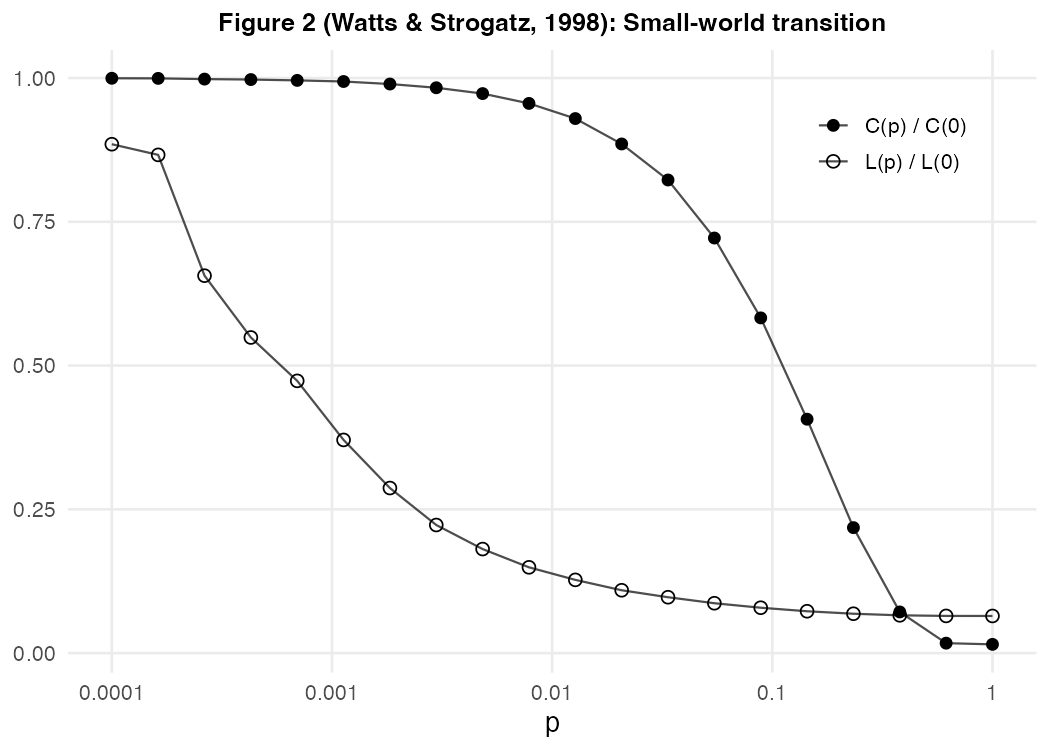
In Figure 2, look at the two curves: the black curve for \(C(p)\) shows the presence of communities or clusters: high at first and then as random re-wirings take over, falling in cliff-like fashion. The gray curve for \(L(p)\) shows the average path length between nodes: high at first, then falling rapidly as random re-wirings create shortcuts across the network.
The region where \(C(p)\) is still high, and \(L(p)\) is already low, is what makes a network a small world: high clustering and short average path lengths. This is the area around \(p \sim 0.01\) in the Figure 2.
Granovetter: Strength of Weak Ties
A very related model is called “the Strength of Weak Ties”. Granovetter showed that in social networks, weak ties (acquaintances) are more important than strong ties (close friends) for spreading information. This is because weak ties connect different communities, allowing information to flow across the network.
Weak ties (acquaintances, infrequent or low-intensity connections) are more important for spreading information, opportunities (e.g., job leads, college admissions!), and innovation across social groups than strong ties (close friends/family).
Strong ties create dense, overlapping clusters (high local redundancy; your friends know each other). Weak ties act as local bridges connecting otherwise separate clusters, providing access to novel information. Empirical observation: People often find jobs through weak ties rather than close friends, because strong-tie circles share similar information.
This highlights a tension: social networks are locally clustered (via strong ties and triadic closure) but globally connected via weak ties.
In a sense, Watts-Strogatz’s model provides the math justification for Granovetter’s empirical observation: the small-world property allows for efficient information flow across a network, even if most connections are local.
Albert-László Barabási and Réka Albert: Preferential Attachment
If you were signing up for a new social media platform, would you rather follow a random user or the most popular user? Most people would choose the latter. This is the essence of preferential attachment, a concept that explains how networks grow and evolve over time.
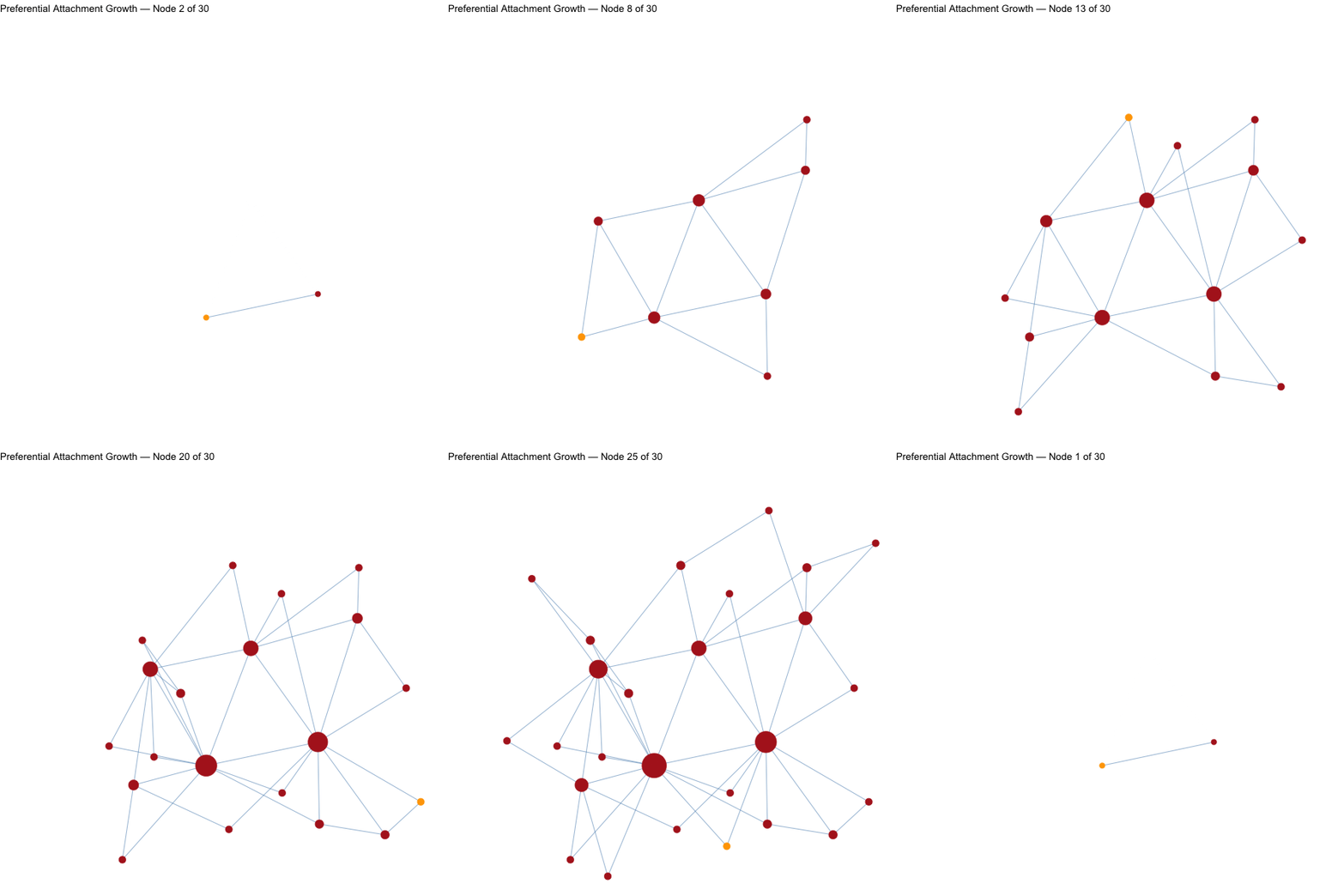
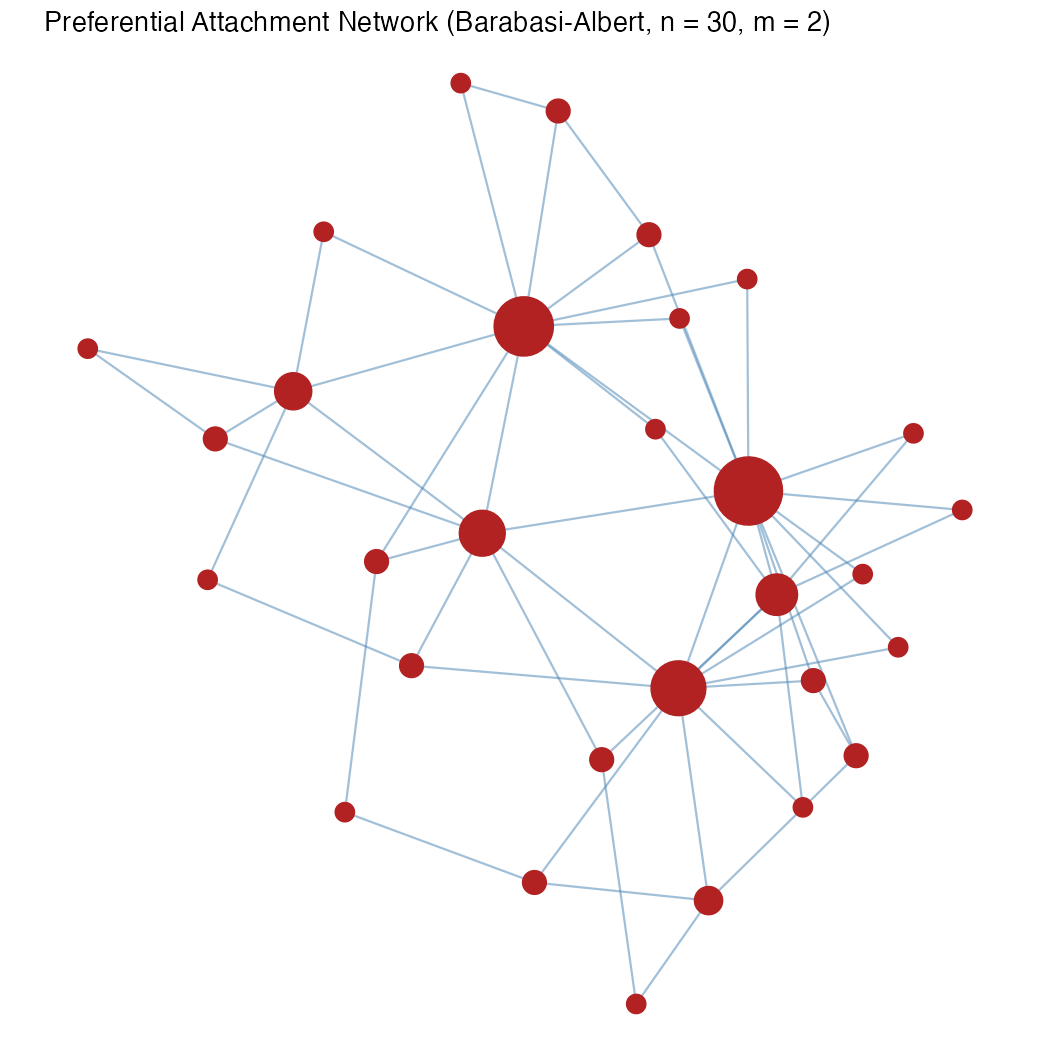
When new nodes are added to a growing network (like web pages or people joining social media), they are more likely to connect to existing nodes that already have many connections. This creates a “rich get richer” effect. This is akin to the Matthew Effect from the Bible:
_(cropped).jpg)
Some examples:
- Imagine a school where kids form friendships.The kid who has the most friends is always invited to more parties (gets more invitations). A new student joins and wants to make friends—instead of randomly picking someone, they choose the kid with the biggest social circle because that’s where the “buzz” is.
- The Internet topology (where some servers are connected to thousands of others)
- Social media networks (a few influencers have millions of followers)
- Biological protein interaction networks (some proteins interact with far more partners than most)
The model is a simplified abstraction, but it provides critical insight into why real-world complex systems exhibit such specific (and to some people, vexing) statistical properties.
Implications
-
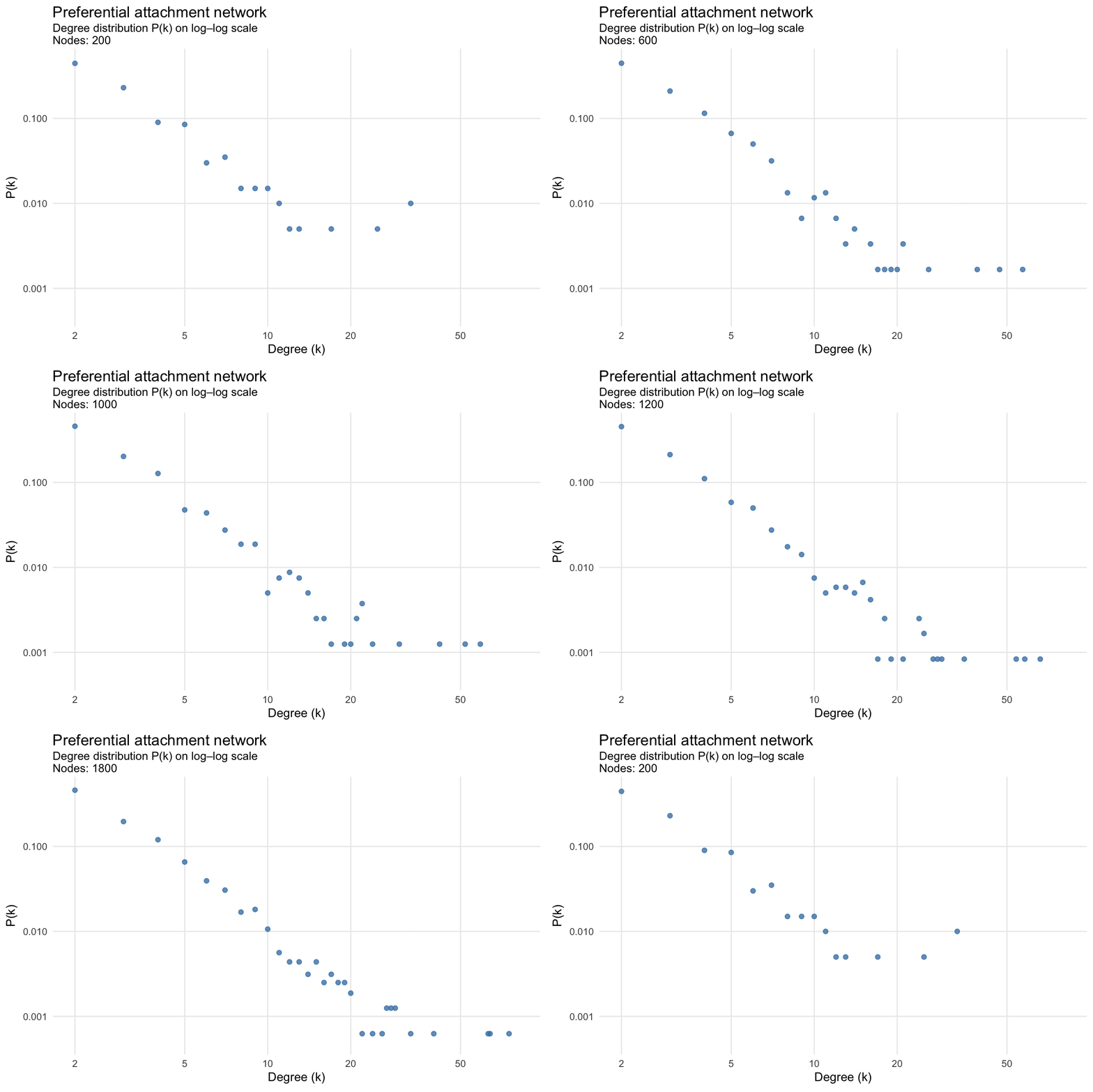
Power-law degree distribution: The probability \(P(k)\) that a node has k connections follows a power law: \(P(k) ∝ k^{-γ}\). This means most nodes have very few connections, but a small number of “hubs” dominate.
-
Self-reinforcing growth: As the network grows, hubs become even larger because they attract more connections. -
Emergence of scale-free structure: Over time, this process creates networks with an infinite number of possible connection paths and robustness against random failures. https://mathinsight.org/scale_free_network
Why It Matters in Art/Design
- The robustness of infrastructure networks (many small links can fail, but hubs remain). OTOH, if these hubs fail, the network comes to a halt. So more money, typically, would be spent in protecting hubs.
- The spread of information or disease through a population is controlled by hubs. Innoculate them, and you are better off.
- If one is on a fund-raising platform, add some seed funds to each new user, and they will be more likely to attract more funds. This is a preferential attachment effect.
Discussion and Questions
- Random is equal; but do we want equal when we want designs, policies, ads to work?
- Are heavy-tailed distributions a bad thing?
- Can network-oriented designs (are there any other kind??) work without creating heavy-tailed distributions?
- Can a business survive serving the non-heavy side of the distribution? (E.g. stocking books by authors who are not best-sellers, or selling to people who are not influencers.) How?
- Can niche be a…niche?
Conclusions
- We are network. Maybe we should make a movie titled
I,RobotWe, Network. - Our Culture, Inventions, Business, Creations are all solidly linked to the Networks we are embedded in.
- Note what Naval Ravikant says “The three big decisions – what you do, where you live, and who you’re with.”
References
- The Network Effects Bible. https://www.nfx.com/post/network-effects-bible
- Herbert Simon. https://thedecisionlab.com/thinkers/computer-science/herbert-simon
- Duncan Watts and Steven Strogatz. (1998). Collective dynamics of ‘small-world’ networks. Nature 393, 440–442. https://snap.stanford.edu/class/cs224w-readings/watts98smallworld.pdf
- The Startup Junkie.* How to be a Connector*. https://startupjunkie.org/2021-12-1-the-power-of-weak-ties-tips-on-how-to-become-the-connector/
- Ran Katzir. Experience Network Science through Play. https://medium.com/@ran_katzir/teaching-network-science-using-board-games-f78489a3b3bd ( Describes an in-design board game.)
- Mitchell Resnick. Beyond the Centralized Mindset. https://web.media.mit.edu/~mres/papers/JLS/JLS-1.0.html
- Thomas W. Valente.(2012). Network Interventions. Science(337) 49. Available here https://sci-hub.se/10.1126/science.1217330. The term “network interventions” describes the process of using social network data to accelerate behavior change or improve organizational performance. In this Review, four strategies for network interventions are described, each of which has multiple tactical alternatives.
- Nicholas Christakis. (May 3, 2024). To exploit social contagion, tools are needed to efficiently identify individuals who are better able to initiate cascades. To be maximally useful, such tools should be deployable without having to actually map face-to-face social network interactions. https://t.co/DHCKxXeGYg. This is a paper that presents design tools that exploit the “Friendship Paradox” to create Social Contagion. A quick summary of the paper is available here. https://www.science.org/doi/10.1126/science.adi5147
- David Pinsoff. (Dec 2025).Everything is Bullshit Substack. https://www.everythingisbullshit.blog/p/a-big-misunderstanding
- fee.org.(Wednesday, September 19, 2018 )How Can Game Theory Prevent Disease Outbreaks.https://fee.org/articles/how-game-theory-can-help-prevent-disease-outbreaks/
Important Papers in Network Science
-
Watts and Strogatz on
Small Worlds Vespigniani on Hubs
Hmmm…need to find this paper.
-
Mark Newman, The Physics of Networks. Good intro Power Laws and examples of many networks.
-
Mark Granovetter. (1973). The Strength of Weak Ties. American Journal of Sociology 78(6): 1360–1380.
Fun Stuff ( ha!)
- Puzzles and Games for Graph Theory. https://www.tes.com/teaching-resource/graph-theory-puzzles-and-games-12164908
- The Erdos Number Projects. https://sites.google.com/oakland.edu/grossman/home/the-erdoes-number-project
- Collab Distance! https://mathscinet.ams.org/mathscinet/freetools/collab-dist
- The Srishti Distance Project. https://There_ain't_no_such_website_yet.html Unless you count PDAs.